
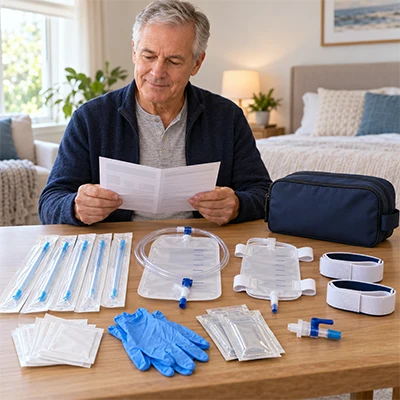
If prostate surgery is on your calendar -- or you're home from it now with a catheter you didn't feel ready for -- this guide is for you. Catheters after prostate surgery come up in two distinct chapters, and most men are only prepared for one of them.
Chapter one is the urinary (Foley) catheter that virtually every man has after a radical prostatectomy, typically for 7 to 12 days while the reconnection between bladder and urethra heals. Chapter two, which affects a smaller group, is intermittent self-catheterization -- some men need it weeks or months later if scar tissue narrows the urinary channel or the bladder doesn't empty completely. This guide covers the practical side of both: living comfortably with the Foley, what's normal and what isn't, what to have ready for the day it comes out, and how self-cathing works if your urologist prescribes it.
One rule sits above everything else here: your surgeon's instructions win. Catheter timing, removal, and any changes to the plan belong to your surgical team. What follows is the practical, day-to-day knowledge that makes their plan easier to live with.
Why the Catheter Is Non-Negotiable After Prostatectomy
When the prostate is removed, the surgeon reconnects the bladder directly to the urethra with sutures -- a connection called the anastomosis. The catheter keeps urine flowing out through a protected channel so that delicate reconnection can heal without urine leaking into the surgical site or pressure building against the sutures. That's why the catheter stays in for roughly 7 to 12 days (your surgeon sets the exact timing), and why it must never be removed early or adjusted at home. A small water-filled balloon inside the bladder holds it in place -- it won't fall out during normal activity, and nothing should ever be pulled.
Men who have less extensive prostate procedures for enlarged prostate (like TURP) usually have a catheter for a much shorter period -- often a day or two -- but the care principles below apply the same while it's in.
Living With the Foley: The Practical Week
Securing the catheter
The single biggest comfort upgrade is proper securement. The catheter tube should be anchored to your thigh with a securement strap or adhesive holder so the tube can't tug at the tip of the penis when you move -- tugging is what causes most of the soreness men report. Leave a little slack between the tip and the anchor point, and alternate legs if the skin gets irritated.
Daytime: the leg bag
During the day you'll wear a leg bag strapped to your thigh or calf under your pants -- most men find nobody can tell it's there. The working rules: keep the bag below bladder level at all times so gravity drains urine away (backflow toward the bladder raises infection risk), empty it every 3 to 4 hours or whenever it's about half full so the weight doesn't drag, and use the drainage tap at the bottom without letting it touch anything. Loose, dark sweatpants or joggers are the uniform of Foley week for a reason.
Here's the tip experienced patients pass along constantly in recovery forums: the basic bag the hospital sends you home with is often the bare minimum, and upgrading to a better leg bag with softer backing, better straps, and a smoother valve makes the whole week noticeably more comfortable. Browse our urology collection for leg bags, night drainage bags, straps, and securement supplies -- having a spare on hand also means a leaky valve never becomes a crisis.
Nighttime: the night bag
At bedtime, connect a large-capacity night drainage bag (2,000 mL) to the outlet at the bottom of your leg bag -- keeping the leg bag connected preserves the closed system, which is one of your main defenses against infection. Open the leg bag's tap so urine flows through to the night bag, hang the night bag on a stand or hook so it sits below mattress level and off the floor, and make sure the tubing runs downhill without kinks. In the morning, close the tap, disconnect the night bag, and empty it. This setup means you sleep through the night without getting up to empty anything.
Hygiene
Wash your hands before and after any catheter handling. Once or twice a day, wash the area where the catheter enters the penis with mild soap and water, wiping along the tube away from your body, and rinse well -- no powders or oil-based creams near the catheter. Daily showering is usually encouraged once your surgeon clears it; the catheter and bag can get wet.
What's normal
Some things that alarm men in Foley week are expected: pink or blood-tinged urine (especially after walking or a bowel movement), a strong urge to urinate or bladder spasms (the balloon irritates the bladder -- mention spasms to your care team, as they can prescribe medication that helps), small leaks of urine around the tube during spasms, and grit or debris in the tubing. Drink steadily through the day -- good urine flow is what keeps the catheter clear.
Call your surgical team promptly if
- No urine has drained for several hours (check for kinks and bag position first)
- You develop fever or chills
- Urine turns frankly bloody (like fruit punch) and doesn't clear with increased fluids
- There's significant pain, swelling, or discharge at the catheter site
- The catheter comes out -- do not attempt to reinsert it yourself
Catheter Removal Day: Have These Ready Before You Go
The catheter comes out at your surgeon's office in a quick, mildly uncomfortable, seconds-long procedure. What most men aren't warned about clearly enough: nearly everyone leaks urine after removal. The muscle that the prostate used to help support now has to do the job alone, and it takes weeks to months of recovery. Walking out of that appointment without protection is the mistake almost every man makes exactly once.
Have these at home before removal day:
- Depend Shields for Men ($7.32) -- discreet, body-shaped light protection worn in regular underwear; the right starting point for lighter leakage
- Prevail Per-Fit Protective Underwear for Men -- male-specific pull-up protection with the absorbent core positioned forward, for moderate leakage in the early weeks
- Tranquility Premium OverNight Absorbent Underwear ($44.61 per case) -- overnight capacity while nighttime control returns
- Prevail Night Time Underpads -- bed protection that saves the mattress and the 3 a.m. sheet change
Most men progress from heavier to lighter products over weeks as pelvic floor strength returns -- buy small quantities of two absorbency levels rather than a case of one. And starting about 3 days after removal (with your surgeon's okay), pelvic floor exercises become the single most effective thing you can do to speed the return of control: our complete guide to doing Kegel exercises correctly covers the technique most men are never actually taught, and it was written with post-prostatectomy recovery specifically in mind.
For men with heavier ongoing leakage, a male external catheter ($1.38 each, or $41.39 per box of 30) -- a condom-style sheath that routes urine to a leg bag with nothing inserted -- can be a practical bridge during recovery, especially overnight or for long outings. The extended-wear version ($2.18) adds an inner flap for skin protection and longer wear. Sizing matters for external catheters; measure per the product guidance and ask your care team if unsure.
Chapter Two: If Intermittent Self-Catheterization Is Prescribed
Months after prostate surgery, a minority of men develop a narrowing where the bladder and urethra were joined (a bladder neck contracture) or elsewhere in the urethra (a stricture), or find their bladder doesn't empty fully. One standard management approach is intermittent self-catheterization: passing a thin, single-use catheter a few times a day (or as prescribed) to empty the bladder or keep the channel open, removing it immediately after. It sounds daunting; nearly every man who learns it reports the same arc -- awkward for a week, routine within a month, and a five-minute task after that.
Why your catheter probably has a curved tip
If your urologist prescribes self-cathing after prostate surgery, they'll very likely specify a coude tip -- a catheter with a slight upward curve at the end. The curve is designed to navigate exactly the terrain prostate surgery creates: the angle and scar tissue at the reconstructed bladder neck that a straight tip can catch on. The rule with a coude catheter: the curved tip points up (toward your navel) throughout insertion, and nothing is ever forced -- if it won't pass, stop and call your urologist.
The supplies
- The Hollister Apogee Intermittent Coude Catheter 14 Fr ($1.73 each) is a reliable everyday coude option -- sterile, single-use, and available in 12 Fr and 16 Fr sizes to match whatever your urologist specifies. (French size = diameter; use exactly the size prescribed.)
- The Bard Touchless Plus Coude Intermittent Catheter Kit 14 Fr ($5.52) is the all-in-one option: a sterile kit with the coude catheter, an 1,100 mL collection chamber, antiseptic swabs, gloves, and an underpad in one package. It's ideal for the learning weeks, for travel, and for cathing anywhere a clean bathroom isn't guaranteed -- no separate supplies to gather, and you never touch the catheter itself. Also available with a red rubber catheter ($7.73) for men who prefer a softer material.
- Sterile lubricating jelly (single-use packets), plus soap or wipes for hand and tip cleaning -- your urology nurse will walk you through the exact routine they want you to follow.
Technique fundamentals your nurse will reinforce: wash hands thoroughly, clean the tip of the penis, lubricate the catheter generously, insert with the coude curve pointing up until urine flows, let the bladder empty completely, and withdraw slowly. Never reuse a single-use catheter -- reuse is strongly associated with urinary tract infections.
Preventing UTIs: The Short Version
Whether it's a Foley or intermittent cathing, infection prevention comes down to the same fundamentals: hands washed before every catheter contact, the drainage system kept closed and below bladder level, bags emptied on schedule without the tap touching anything, steady fluid intake all day, and single-use supplies never reused. Burning that persists, cloudy foul-smelling urine, fever, or new pain are the signals to call your care team rather than wait.
Your Supply Checklist
| Phase | What to Have |
|---|---|
| Foley week | Quality leg bag + night drainage bag + securement straps, night bag stand or hook, mild soap, loose dark clothing |
| Removal day (before you go) | Depend Shields for Men, Prevail Per-Fit men's underwear, underpads for the bed |
| Recovery weeks | Step-down absorbency products, Kegel routine, optional external catheter for outings/overnight |
| If self-cathing prescribed | Apogee coude catheters in your prescribed Fr size, Touchless Plus kits for travel, sterile lubricant |
It Gets Better -- Genuinely
The Foley week feels endless while you're in it, and the first leaky weeks after removal can be discouraging. But the pattern in every prostate recovery community is remarkably consistent: continence improves steadily for most men over the first three to six months (and continues improving up to a year), self-cathing -- when it's needed at all -- becomes an unremarkable routine, and the catheter chapter ends up a footnote in the recovery story. Prepare the supplies, do the Kegels, keep your care team in the loop, and give it time.
Shop Related Products
- Urology Collection -- Leg Bags, Night Bags, and Catheter Supplies
- Hollister Apogee Intermittent Coude Catheter 14 Fr -- everyday coude self-cathing
- Bard Touchless Plus Coude Catheter Kit 14 Fr -- all-in-one sterile kit for travel and learning weeks
- Hollister Everyday Male External Catheter and Extended Wear version -- non-invasive bridge for post-removal leakage
- Depend Shields for Men -- discreet light protection for removal day
- Tranquility Premium OverNight Absorbent Underwear -- overnight capacity while control returns
- Prevail Night Time Underpads -- mattress protection
- Men's Incontinence Products
Disclaimer: This information is intended for educational purposes only and should not replace advice from your surgeon, urologist, or care team. Catheter management after prostate surgery -- including removal timing, catheter sizing, and self-catheterization technique -- must follow your surgical team's specific instructions. Never remove, reinsert, or adjust a post-surgical catheter yourself. Seek prompt medical attention for no urine drainage, fever, frank blood in urine, or a catheter that has come out.