
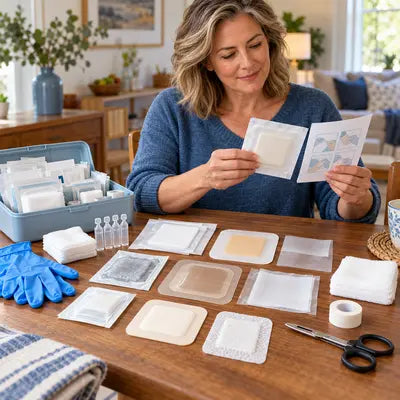
Walk into the wound care aisle -- or scroll the category online -- and you meet an alphabet soup: hydrocolloid, alginate, foam, film, collagen matrix. The products look similar, the names explain nothing, and the price range runs from a few dollars to a few thousand. Meanwhile, the person actually changing a dressing at home -- a caregiver managing a parent's pressure injury, someone healing a surgical wound, anyone the home health nurse visits twice a week but who handles the other five days alone -- mostly just needs to know: which one, and why?
This is the plain-English decoder. One scope note before we start: this guide is for wounds being managed at home under professional guidance -- a doctor, home health nurse, or wound care nurse has seen the wound and set the plan. It explains what each dressing type does so you can follow that plan confidently and restock the right supplies. It is not a substitute for having a wound assessed, and some wounds (we'll name them) should never be self-managed.
The One Principle Behind All of It: Moist Wound Healing
The biggest myth in home wound care is "let it air out." Decades of wound research say the opposite: wounds heal faster, with less pain and less scarring, in a moist, covered environment. New skin cells migrate across a moist wound surface far more easily than across a dried-out scab, and a good dressing holds that healing environment steady between changes while keeping bacteria out.
Every advanced dressing category exists to solve the same equation from a different starting point: keep the wound moist but not soggy. A dry wound needs a dressing that donates or traps moisture. A heavily draining wound needs a dressing that absorbs the excess. That single axis -- how much fluid (exudate) the wound produces -- is the main thing that decides which dressing belongs on it.
The Home Dressing-Change Routine
- Wash your hands before and after, every time. Gloves if you have them.
- Cleanse gently -- saline or the cleanser your care team specified, poured or sprayed over the wound. No scrubbing, and skip harsh agents like peroxide or alcohol on healing tissue unless your care team has specifically directed them.
- Protect the skin around the wound. The periwound skin takes a beating from moisture and repeated adhesive. A barrier film like Smith and Nephew Skin-Prep Protective Barrier Wipes wiped on the surrounding skin (not the wound bed itself) shields it from maceration and adhesive trauma.
- Apply the dressing your plan calls for -- sized so it overlaps the wound edges onto healthy skin.
- Change on schedule, not on habit. Advanced dressings are designed to stay on for days; changing daily "to check" destroys the healing environment they build. Change when your plan says to, or when the dressing is saturated or leaking.
The Dressing Types, Decoded
Hydrocolloids: the self-contained healers
A hydrocolloid is a flexible adhesive wafer -- the same gel-forming technology as ostomy barriers -- that sticks around the wound, seals it from the outside world, and turns wound fluid into a gel that keeps the surface moist. The classic of the category is ConvaTec DuoDERM CGF Hydrocolloid Dressing 4" x 4" ($8.26 each, or $41.30 per box of 5; also in 6" x 8" for larger areas).
Best for: wounds with light to moderate drainage -- commonly early-stage pressure injuries, shallow ulcers, and skin tears per your care plan. They stay on for several days at a time (your plan sets the interval), shower-tolerant and low-fuss.
Worth knowing: when you remove a hydrocolloid, you'll find yellowish gel on the wound that can look and smell alarming. That melted gel is the dressing doing its job, not infection -- rinse it away at the change and judge the wound underneath. (Infection signs are listed below.)
Alginates: the heavy-drainage absorbers
Alginate dressings are made from seaweed-derived fibers that absorb many times their weight in fluid, turning into a soft gel as they work. They're the answer for wounds that soak through ordinary dressings.
- Hollister Restore/CalciCare Calcium Alginate 2" x 2" ($2.78 each) and 4" x 8" ($9.72 each) -- flat dressings for draining surface wounds
- Restore Calcium Alginate 12" Rope ($4.06 each) and ConvaTec Kaltostat 2g Rope ($11.75 each) -- rope form, which a nurse may direct you to gently lay into deeper wounds so they heal from the bottom up rather than closing over a pocket
Best for: moderately to heavily draining wounds. Worth knowing: alginates aren't adhesive -- they always need a secondary dressing (gauze and tape, a film, or a foam) to hold them in place, so stock both. And packing a wound cavity is a technique your nurse should demonstrate before you do it solo.
Silver dressings: when bacteria are part of the problem
Silver has broad antimicrobial action, and silver-impregnated dressings like the Hollister Restore Calcium Alginate with Silver 12" Rope ($15.55 each) combine alginate absorbency with sustained silver release. These are typically added to a care plan when a wound is critically colonized or infection risk is high -- which is exactly why they belong in the clinician-directed column: use them when your wound care team puts them in the plan, not as a just-in-case upgrade.
Films and foams: the supporting cast
Transparent films are thin adhesive sheets for minor superficial wounds and for securing other dressings while letting you see underneath. Foam dressings are cushioned absorbers for moderate drainage, especially over pressure points. Both categories live in our wound care collection alongside the products above -- if your plan names a specific film or foam, search the product name or send us the name from your discharge paperwork and we'll match it.
Collagen and skin-substitute matrices: the advanced tier
At the top of the ladder sit extracellular matrix (ECM) and collagen dressings -- sterile scaffolds derived from biological tissue that give stalled, hard-to-heal wounds a structure to rebuild into. We stock the Hollister Endoform Natural Dressing 2" x 2" ($164.78 per box of 10) and the Oasis Fenestrated Wound Matrix ($2,486.48 per box of 10).
Plain English on these: they are genuinely remarkable products for chronic wounds that have refused to heal -- and they are not DIY products. They're selected and applied under the direction of a wound care professional, with the home role usually limited to protecting the site between visits. We carry them so patients whose care plans include them can refill without the runaround, not because anyone should self-prescribe a skin substitute.
Matching Dressing to Wound: The Short Version
| The Wound Is... | The Category | Our Stocked Example |
|---|---|---|
| Minor, superficial, barely draining | Transparent film | Wound care collection |
| Shallow with light-moderate drainage | Hydrocolloid | DuoDERM CGF 4" x 4" -- $8.26 |
| Draining moderately, over a pressure point | Foam | Wound care collection |
| Draining heavily | Alginate | CalciCare 4" x 8" -- $9.72 |
| Deeper, needs packing (nurse-directed) | Alginate rope | Restore 12" Rope -- $4.06 |
| High bacteria concern (clinician-directed) | Silver alginate | Restore with Silver -- $15.55 |
| Chronic and stalled (professional care) | Collagen / ECM matrix | Endoform, Oasis Matrix |
Wounds That Should Never Be Self-Managed
Some wounds need a professional driving the plan from day one, every time:
- Any foot wound in a person with diabetes. Diabetic foot ulcers can deteriorate fast and quietly -- reduced sensation hides the warning signs. Same-week professional evaluation, always. (Good glucose control is also wound-healing fuel: persistently high blood sugar impairs healing, which is one more reason consistent monitoring matters -- our glucose meter guide covers the tools.)
- Wounds that aren't improving after about two weeks of consistent care -- stalled wounds need reassessment, not a bigger dressing.
- Deep wounds, or wounds with tunneling or undermining you can't see the bottom of.
- Suspected pressure injuries beyond the earliest stage in someone bedbound or chair-bound -- staging and offloading need professional eyes.
- Leg ulcers -- venous and arterial ulcers look similar and are treated almost oppositely; compression applied to the wrong one causes harm.
Call Your Provider Promptly For
- Spreading redness or warmth around the wound, or red streaking away from it
- Increasing pain, swelling, or foul odor (after rinsing away dressing gel)
- Thick colored discharge, or drainage that suddenly increases
- Fever or feeling generally unwell
- Wound edges turning dark or black
Protecting Skin Before It Becomes a Wound
The best wound care is the wound that never opens. If you're managing incontinence, moisture-damaged skin is the usual on-ramp to pressure injuries -- our guide to preventing and treating incontinence-associated dermatitis covers the cleanse-moisturize-protect routine that keeps skin intact. And for ostomates, the same moist-damage mechanics around the stoma are covered in our peristomal skin complications guide.
Shop Related Products
- ConvaTec DuoDERM CGF Hydrocolloid 4" x 4" -- the hydrocolloid standard, $8.26
- DuoDERM CGF 6" x 8" -- larger coverage, $12.88
- Restore Calcium Alginate 2" x 2" -- $2.78
- CalciCare Calcium Alginate 4" x 8" -- $9.72
- Restore Calcium Alginate 12" Rope -- $4.06
- ConvaTec Kaltostat Alginate Rope -- $11.75
- Restore Calcium Alginate with Silver Rope -- $15.55
- Smith and Nephew Skin-Prep Barrier Wipes -- periwound skin protection
- Hollister Endoform Natural Dressing -- clinician-directed collagen matrix
- Oasis Fenestrated Wound Matrix -- clinician-directed ECM skin substitute
- Browse the Full Wound Care Collection
Disclaimer: This information is intended for educational purposes only and should not replace advice from your healthcare provider or wound care nurse. Dressing selection, wound packing technique, and any use of silver, collagen, or skin-substitute products should follow a care plan set by a professional who has assessed your wound. Seek prompt medical attention for the infection signs listed above, for any foot wound if you have diabetes, and for any wound that is not steadily improving.