
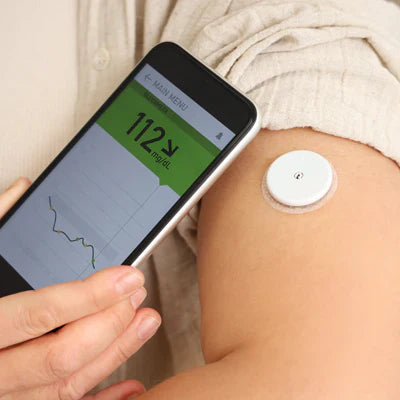
For decades, continuous glucose monitors (CGMs) were exclusively prescription devices -- expensive, insurance-dependent, and mostly associated with type 1 diabetes management. That changed in 2024, when the FDA cleared the first over-the-counter CGMs, and the landscape has been shifting quickly ever since.
If you have type 2 diabetes and don't use insulin, or if you've been told you have prediabetes and want a better window into how your body handles blood sugar, there are now three OTC options worth knowing about: Dexcom Stelo, Abbott Lingo, and Abbott Libre Rio. No prescription required, no insurance hurdles -- just order and go.
But are they actually worth the cost? Here's what you need to know before you buy.
What Makes OTC CGMs Different from Prescription CGMs?
Like prescription CGMs, OTC devices use a small sensor inserted just under the skin to measure glucose in the interstitial fluid continuously, day and night. You get a running picture of your blood sugar trends without finger pricks.
But there are some important differences from prescription devices:
- No low or high glucose alarms. Prescription CGMs like the Dexcom G7 or FreeStyle Libre 3 can alert you when glucose drops dangerously low or spikes too high. OTC devices do not have this feature -- they are designed for trend monitoring, not urgent safety alerts. This is why they are not appropriate for insulin users or anyone at risk of severe hypoglycemia.
- No integration with insulin pumps. OTC CGMs cannot connect to automated insulin delivery systems.
- Adults only. All three OTC devices are cleared for ages 18 and up.
- Not covered by insurance in most cases, though all are HSA/FSA eligible.
If you use insulin, have a history of severe low blood sugar, or have type 1 diabetes, an OTC CGM is not the right tool -- you need a prescription device with full alarm capabilities. But for the large population of type 2s managing with diet, exercise, and oral medications, these devices open up a genuinely useful window into blood sugar that wasn't accessible before.
Dexcom Stelo
Stelo was the first OTC CGM cleared by the FDA (March 2024) and launched for sale in August 2024. It is built on the same core technology as the Dexcom G7 and has a MARD (Mean Absolute Relative Difference -- the standard CGM accuracy measure) of 8.3%, making it the most accurate of the three OTC options.
Who it's for: Adults 18+ with type 2 diabetes or prediabetes who do not use insulin, and anyone interested in metabolic health monitoring. Not recommended for people prone to hypoglycemia.
Wear time: 15 days per sensor -- the longest of any OTC biosensor currently available. Fully waterproof up to 8 feet for 24 hours.
Readings: Measures glucose every 5 minutes, with data sent to the app every 15 minutes. 30-minute warm-up after insertion. Includes a 12-hour grace period at the end of each sensor session so you can overlap sensors without a data gap.
App features: Real-time glucose data, trend patterns, glucose variability insights, AI-powered meal logging, and GenAI-generated insights. Integrates with Apple Health and Android. Provider sharing available via Clarity Clinic.
Pricing: $99 pay-as-you-go for a 2-sensor pack (30 days), or $89/month on subscription. HSA/FSA eligible.
Best for: Type 2s who want the most accurate OTC sensor, prefer data-forward insights over coaching, and want the longest wear time per sensor.
Abbott Lingo
Lingo is Abbott's wellness-focused OTC biosensor, FDA-cleared in June 2024. It uses technology similar to Abbott's FreeStyle Libre line and is positioned as a general metabolic health tool. Importantly, Lingo is not FDA-cleared for people with diabetes -- it is designed for health-conscious adults who want to understand how food, exercise, and sleep affect their glucose without necessarily having a diabetes diagnosis.
Who it's for: Adults 18+ interested in metabolic health and wellness optimization. Not cleared for use by people with diabetes.
Wear time: 14 days per sensor.
Readings: Measures glucose every minute in real-time. One-hour warm-up after insertion.
Accuracy: MARD of approximately 9.3% -- slightly less accurate than Stelo but reliable for wellness-level monitoring.
App features: Real-time glucose tracking, a proprietary daily metric called the Lingo Count, weekly progress reports, personalized food and exercise recommendations, in-app coaching, and Apple Health integration.
Pricing: $49 for a single 2-week sensor, $89 for a 2-sensor 4-week supply, or $249 for a 12-week subscription (roughly $83/month). HSA/FSA eligible.
Best for: People without a diabetes diagnosis who want coached, habit-building guidance around diet and metabolic health. If you have been diagnosed with type 2 diabetes, Stelo or Libre Rio are the better fit.
Abbott Libre Rio
Libre Rio received FDA clearance in June 2024 alongside Lingo but has not yet had a full commercial launch in the US as of early 2026. It fills a slightly different niche -- specifically designed and cleared for type 2 diabetes management rather than general wellness.
Who it's for: Adults 18+ with type 2 diabetes who do not use insulin and typically manage their condition through lifestyle modifications.
Wear time: 15 days per sensor.
Glucose range: 40 to 400 mg/dL -- the widest measurement range of the three OTC devices.
App features: Personalized insights, in-app coaching, and Apple Health integration -- similar to Lingo in its coaching-forward approach but cleared for type 2 diabetes use.
Pricing: Not yet publicly announced. Check the Abbott website for availability updates.
Best for: Once available, Libre Rio is expected to be a strong option for type 2s who prefer Abbott's ecosystem and coaching approach over Dexcom's data-forward style.
Side-by-Side Comparison
| Dexcom Stelo | Abbott Lingo | Abbott Libre Rio | |
|---|---|---|---|
| FDA intended use | Type 2, prediabetes, wellness | General wellness only | Type 2 (not on insulin) |
| Wear time | 15 days | 14 days | 15 days |
| Accuracy (MARD) | 8.3% | 9.3% | Not yet published |
| Reading frequency | Every 5 min | Every 1 min | TBA |
| Low glucose alerts | No | No | No |
| Monthly cost | $89-$99 | $83-$99 | TBA |
| HSA/FSA eligible | Yes | Yes | Expected yes |
| Available now | Yes | Yes | Not yet launched |
So -- Are They Worth It?
For the right person, yes. Here's how to think about it:
If you have type 2 diabetes and want to understand how your daily choices affect your blood sugar -- what you eat, when you exercise, how stress and sleep play in -- an OTC CGM gives you real-time feedback that no amount of twice-daily finger sticks can match. Seeing your glucose spike after a specific meal and then flatten with a 15-minute walk is the kind of immediate, personal data that changes behavior in a way that abstract A1C numbers often don't.
If your A1C is already well controlled and you're stable on oral medications, the day-to-day value may be lower -- but many people find even a single month of CGM use genuinely educational for building long-term habits.
If cost is a concern, HSA and FSA funds can be used for both Stelo and Lingo, which can reduce the out-of-pocket impact significantly. At roughly $83-$99/month, these are not cheap -- but they are considerably less expensive than prescription CGMs paid out of pocket.
If you have prediabetes, the case is compelling. No prescription needed, the devices are designed for exactly this use case, and the real-time feedback can be a powerful motivator for the lifestyle changes that prevent progression to type 2 diabetes.
Still Need Traditional Testing Supplies?
Even if you add an OTC CGM to your routine, keeping a reliable glucose meter and test strips on hand makes sense -- for confirming readings, for days when your sensor is between changes, and as a backup. At Best Buy Medical Supplies, we carry a full range of glucose meters, test strips, lancets, and lancing devices from trusted brands at competitive prices.
Browse our diabetic supplies collection to stock up on everything you need to stay on top of your blood sugar management.
Disclaimer: This information is intended for educational purposes only and should not replace advice from your healthcare provider. Always consult with your diabetes care team before making changes to your monitoring routine or treatment plan. OTC CGMs are not appropriate for insulin users or individuals with a risk of severe hypoglycemia.