
If you've been living with an ostomy for any length of time, you've likely encountered the terms "flat barrier" and "convex barrier" -- and if you're still using whichever one the hospital sent you home with, you may not realize there's another option that could be working significantly better for you.
Choosing between a flat and a convex ostomy barrier is one of the most consequential product decisions an ostomate makes. The right choice produces a secure, leak-free seal day after day. The wrong choice -- even with perfect application technique -- leads to leaks, skin breakdown, and the constant low-level anxiety of wondering whether your pouch is going to fail at the worst possible moment.
Here's a straightforward guide to understanding the difference, identifying which type suits your anatomy, and knowing when it might be time to switch.
What Is a Flat Ostomy Barrier?
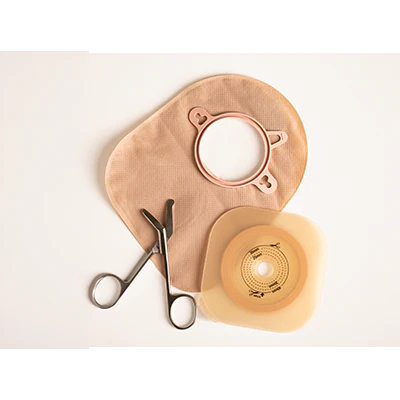
A flat ostomy barrier is exactly what it sounds like -- the adhesive wafer that attaches to your skin lies flat against the body. It's the most commonly used barrier type and the standard starting point for most new ostomates. Flat barriers work well when the stoma protrudes adequately above the skin surface and the surrounding abdominal area is relatively even and firm.
Flat barriers come in several formulations -- standard wear and extended wear -- with extended wear options designed to hold longer against liquid output or in challenging conditions like heat and humidity. They're available in pre-cut sizes and cut-to-fit options that you trim to your stoma's exact measurement.
Flat barriers work best when:
- Your stoma protrudes at least 1/2 inch (about 1 to 1.5 cm) above the skin surface
- The skin surrounding your stoma is relatively flat and even
- Your abdominal contour around the stoma is firm, without significant skin folds or creases
- You are not experiencing frequent unexplained leaks despite good application technique
Well-known flat barrier options available at Best Buy Medical Supplies include the ConvaTec Sur-Fit Natura Stomahesive Cut-to-Fit Wafers, the Hollister New Image FlexWear Standard Wear Skin Barrier, and the Hollister New Image Flextend Extended Wear Skin Barrier for situations where longer wear time is needed.
What Is a Convex Ostomy Barrier?
A convex barrier has a curved, dome-like profile that slopes inward toward the center opening. When applied, this curved surface presses gently but firmly against the peristomal skin, pushing it outward and encouraging the stoma to protrude through the barrier opening. This creates a tighter, more elevated seal around the base of the stoma -- which is exactly what's needed when a flat barrier can't create that seal on its own.
Convex barriers are not a niche product. Their use has increased significantly over the past two decades as ostomy surgery techniques have evolved, obesity rates have risen (a thicker abdominal wall makes stoma protrusion more difficult), and WOC nursing practice has shifted toward recommending convexity earlier and more proactively. A 2026 analysis in STAT News noted that CMS has actually flagged the increased use of convex barriers as a concern -- but ostomy care specialists have pushed back strongly, arguing the increase simply reflects better care and changing patient populations.
Convex barriers come in two main depth variations:
- Soft or shallow convexity: A gentler curve, appropriate for stomas that sit at or slightly below skin level, or for use on more sensitive or fragile skin. Options like the Hollister New Image Flextend Convex Extended Wear Barrier and the ConvaTec Sur-Fit Natura Durahesive Convex Barriers fall into this category.
- Deep convexity: A more pronounced curve for significantly retracted stomas or deeper skin folds. Products like the Coloplast SenSura Mio Soft Convex and Coloplast Deep Convex options are designed for these situations.
All major brands have their own convex barrier lines. At Best Buy Medical Supplies you'll find convex options from ConvaTec, Coloplast, and Hollister across both one-piece and two-piece systems.
Signs You May Need to Switch from Flat to Convex
This is the most important section of this guide. Many ostomates are using flat barriers and experiencing ongoing problems that would be resolved -- or significantly improved -- by switching to convex. The challenge is that leaks and adhesion failure can have multiple causes, and it's not always immediately obvious that barrier type is the root issue.
Consider a convex barrier if you're experiencing any of the following:
Frequent leaks under the barrier despite good technique
If you're applying your barrier carefully, getting a clean dry surface, and still experiencing leaks -- particularly output seeping under the inner edge of the barrier closest to the stoma -- this is one of the clearest signals that a flat barrier isn't creating a tight enough seal at the base of the stoma. A convex barrier that presses the peristomal skin outward creates a much tighter junction at that critical point.
A stoma that sits flush with or below the skin surface
A stoma should ideally protrude about 1/2 to 1 inch above the skin. Many stomas don't -- particularly those created during emergency surgery (where there's less opportunity for optimal siting and construction), in people with higher body weight, or those that have retracted over time due to weight gain, hernia, or natural tissue changes. A retracted or flush stoma simply can't form an adequate seal with a flat barrier -- the output has a direct path under the wafer rather than into the pouch.
Skin folds or creases around the stoma
Even if the stoma itself protrudes adequately, skin folds, creases, or an uneven abdominal surface in the peristomal area can create channels where output escapes under a flat barrier. Convex barriers, by pressing the surrounding tissue outward and downward, help even out these contours and create a more uniform seal.
Pancaking
Pancaking occurs when stool presses up against the inside of the barrier rather than dropping into the pouch -- essentially the output "pancakes" at the top of the pouch rather than collecting at the bottom. While this can have multiple causes, one contributor is a stoma that doesn't protrude adequately to direct output away from the barrier surface. Convexity can help by improving stoma protrusion and directing output more reliably into the pouch body.
Short wear time
If you're changing your barrier every one to two days because of leaks or lifting, and skin care and application technique aren't the issue, barrier type is a likely culprit. Properly fitted convex barriers consistently produce longer, more reliable wear times for the patients who need them.
When Flat Barriers Are Still the Better Choice
Convex isn't always the answer. There are situations where flat barriers are clearly preferable:
- A well-protruding stoma with flat, even peristomal skin: There's no benefit to adding convexity when a flat barrier is already creating a reliable seal. Using convex barriers unnecessarily can cause pressure on healthy peristomal skin without providing any advantage.
- Parastomal hernia: A hernia changes the abdominal contour significantly and requires careful assessment. Rigid convex barriers can create uneven pressure on herniated tissue. Flexible or soft convex options, or flat barriers with additional accessories like barrier rings, may be more appropriate. This is a situation that specifically warrants WOC nurse input.
- Sensitive or fragile peristomal skin: The pressure exerted by convex barriers, while generally gentle, can be problematic for very fragile or already-compromised skin. Soft convex options are available for these situations, but again, professional guidance helps.
- Short-term post-surgical period: In the immediate weeks after surgery, stomas often have more swelling and may protrude adequately even if they'll retract later. Many people start on flat barriers and transition to convex as their stoma and body settle into their post-surgical state.
The Role of Barrier Accessories: A Middle-Ground Option
For stomas that are borderline -- not quite needing full convexity but not getting a reliable seal from a flat barrier alone -- barrier rings and sealing rings can sometimes bridge the gap. Products like the Hollister Adapt CeraRing, the ConvaTec Eakin Cohesive Slims, and the Hollister Adapt Convex Barrier Rings can be used to add a degree of convexity to a flat barrier system, or to fill in peristomal contour irregularities.
These accessories are not a substitute for a properly fitted convex barrier when one is genuinely needed -- but they're a useful tool in the middle range and can extend wear time and improve seal security when used correctly alongside either flat or convex barriers.
How to Assess Your Own Situation
If you're unsure whether your stoma protrudes adequately for a flat barrier, here's a simple self-assessment. With clean, dry skin and in a standing position (which most closely reflects how your pouch will perform throughout the day), look at the stoma from the side. Does it rise clearly above the surrounding skin surface? Or does it sit level with or below the skin?
Repeat the assessment in different positions -- sitting, bending, and lying down -- because stoma protrusion can change significantly with posture. A stoma that protrudes adequately when lying down may retract flush with the skin when sitting, making a flat barrier inadequate for daily wear even if it seems fine during application.
If the stoma protrudes less than about 1/2 inch in any common daily position, convex is likely worth exploring.
Work with Your WOC Nurse Before Switching
While this guide gives you the tools to assess your own situation and have an informed conversation, switching between flat and convex barriers -- particularly moving to deeper convexity -- is ideally done with input from a wound, ostomy, and continence (WOC) nurse. They can assess your stoma profile and peristomal anatomy directly, recommend the appropriate depth and type of convexity, ensure the new barrier is being applied correctly, and monitor for any pressure-related skin issues during the transition.
If you don't currently have a WOC nurse, your surgeon or primary care provider can provide a referral. The WOCN Society also maintains a WOC nurse locator at wocn.org if you need help finding one in your area.
Browse Flat and Convex Barriers at Best Buy Medical Supplies
Whether you're maintaining your current system or exploring a switch, Best Buy Medical Supplies carries a comprehensive range of ostomy skin barriers from ConvaTec, Coloplast, and Hollister -- including flat, soft convex, and deep convex options in both one-piece and two-piece systems, pre-cut and cut-to-fit.
- Two-piece skin barriers -- flat and convex
- Convex ostomy barriers
- One-piece pouching systems including convex options
- Barrier rings and sealing rings
- Skin prep barriers and wipes
Browse our full ostomy care collection or reach out if you need help identifying the right products for your system.
Disclaimer: This information is intended for educational purposes only and should not replace advice from your healthcare provider or WOC nurse. Changes to your pouching system -- particularly switching to convex barriers -- should ideally be made in consultation with a WOC nurse or ostomy care specialist who can assess your individual anatomy and needs.
Want the fundamentals of pouch selection, skin care, and daily ostomy life in one place? Start with our top 10 ostomy questions answered.