
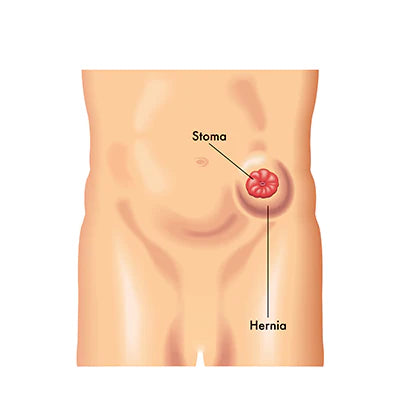
Parastomal hernia is one of the most common long-term complications of ostomy surgery -- and one of the least talked about before it happens. Studies show that up to 50% of ostomates will develop some degree of parastomal hernia within five years of surgery. Yet many people aren't told what to watch for, what increases their risk, or -- most importantly -- what they can do to reduce the likelihood of it developing in the first place.
This guide covers the essential facts about parastomal hernia: what it is, why it happens, who is most at risk, how to recognize the signs, and what the evidence says about prevention and management -- including the role of support belts, which are the most widely recommended conservative intervention.
What Is a Parastomal Hernia?
A parastomal hernia occurs when abdominal contents -- usually part of the intestine or fatty tissue -- protrude through the weakened area of the abdominal wall surrounding the stoma. When a surgeon creates a stoma, they make an opening in the abdominal wall muscle. This opening is a permanent weak point, and over time, the pressure from inside the abdomen can push tissue through it, creating a bulge under or around the stoma.
Parastomal hernias are the most common type of hernia in people with ostomies. They can range from a subtle soft bulge that's only noticeable when you bear down or cough, to a large, persistent protrusion that significantly changes the contour of the abdomen around the stoma. Most parastomal hernias are not immediately dangerous -- but they can grow over time, cause discomfort, and create significant challenges with pouching system fit and adhesion.
The term "parastomal" means "beside the stoma" -- the hernia occurs in the tissue around the stoma rather than through the stoma itself. It's different from a prolapsed stoma (where the bowel slides outward through the stoma opening) and different from a wound hernia in a different part of the abdomen.
Why Parastomal Hernias Are So Common
The anatomy of an ostomy creates inherent vulnerability. The abdominal wall is a layered structure of muscle, fascia, and connective tissue that holds abdominal contents in place under significant internal pressure. When an opening is made through this structure for the stoma, the natural tensile strength of that area is permanently reduced. No matter how well the surgery is performed, this weak point exists.
Several factors determine how quickly or severely a hernia develops:
- Increased intra-abdominal pressure: Any activity or condition that raises pressure inside the abdomen -- coughing, straining, heavy lifting, constipation, obesity -- pushes against the weakened area repeatedly. Over months and years, this pressure can cause the hernia to develop and enlarge.
- Collagen and connective tissue quality: The strength of the repair around the stoma depends partly on the quality of the patient's connective tissue. Conditions that impair healing -- including steroid medications, malnutrition, and some connective tissue disorders -- increase hernia risk.
- Stoma location: Stomas placed outside the rectus abdominis muscle (the central abdominal muscle) have higher hernia rates than those placed through it, though stoma placement is determined by surgical anatomy and not always controllable.
- Time: Risk increases with time. The longer someone has an ostomy, the greater the cumulative exposure to the pressure and mechanical stress that causes hernias to develop.
Who Is Most at Risk?
While any ostomate can develop a parastomal hernia, certain factors significantly increase the likelihood:
- Obesity or high BMI: Excess abdominal fat increases intra-abdominal pressure and places greater stress on the weakened stoma site. This is one of the strongest risk factors for parastomal hernia development.
- Chronic cough: COPD, asthma, allergies, smoking-related cough, or any condition causing repeated coughing creates ongoing pressure surges against the abdominal wall. Each cough generates a spike in intra-abdominal pressure.
- Heavy lifting: Strenuous activity and heavy lifting -- especially in the first three months after surgery, when the wound is still healing -- significantly increases hernia risk. This includes occupational lifting as well as exercise.
- Constipation and straining: Repeated straining during bowel movements generates sustained intra-abdominal pressure. For colostomy patients, constipation is a preventable hernia risk factor.
- Corticosteroid use: Medications like prednisone impair wound healing and weaken connective tissue, increasing vulnerability to hernia formation at the stoma site.
- Emergency ostomy surgery: Hernias are more common after emergency surgery (e.g. for bowel obstruction or perforation) compared to elective surgery, partly because the abdominal wall may be compromised and prophylactic measures less feasible.
- Older age: Natural decline in muscle mass and connective tissue strength with age increases hernia risk.
Recognizing the Signs of a Parastomal Hernia
Early recognition matters because small hernias are easier to manage conservatively than large ones. Watch for the following signs -- and report any of them to your WOC nurse or surgeon promptly:
Visual and physical changes
- A soft bulge or swelling around or beneath the stoma, particularly noticeable when standing, coughing, or straining
- A visible change in the contour of the abdomen around the stoma -- the area may look or feel uneven or asymmetrical
- The stoma appearing to shift position, retract, or change shape as the hernia develops
- Difficulty getting your pouching system to lie flat against the skin
Pouching system changes
- Increased leaks or shortened wear time -- a hernia changes the contour of the peristomal skin, which can interfere with barrier adhesion
- Difficulty finding a barrier shape that provides a reliable seal
- The pouch hanging differently or feeling less secure than it used to
Symptoms
- A dragging or heaviness sensation around the stoma, especially when standing or active
- Mild discomfort or aching around the stoma site, particularly after activity
- Changes in output consistency or frequency as the hernia affects the bowel
When to seek immediate medical attention
Most parastomal hernias are not emergencies -- but some situations are. Seek urgent medical care if you experience:
- Sudden severe pain around the stoma
- A hernia that was previously reducible (could be pushed back in) becoming firm, hard, or unable to reduce
- No stoma output for several hours combined with nausea, vomiting, or abdominal distension
- Skin over the hernia becoming red, warm, or discolored
These symptoms may indicate a strangulated or incarcerated hernia -- a surgical emergency where the blood supply to the herniated tissue is compromised. Do not wait.
Prevention: What the Evidence Says
Not all parastomal hernias can be prevented -- but the evidence supports several strategies that meaningfully reduce the risk, particularly in the first year after surgery when the abdominal wall is still consolidating around the stoma site.
Surgical prevention: prophylactic mesh
The most significant advance in parastomal hernia prevention is the use of prophylactic mesh placement at the time of initial ostomy surgery -- reinforcing the abdominal wall opening before a hernia has a chance to develop. The European Hernia Society's updated guidelines support prophylactic mesh for patients at elevated risk. If you are facing ostomy surgery and have any of the risk factors listed above, asking your surgeon about prophylactic mesh is worth the conversation.
Ostomy support belts: the most accessible prevention tool
For people who have already had their ostomy created, wearing a well-fitted ostomy support belt is the most widely recommended and most accessible prevention strategy. Support belts provide circumferential compression around the stoma site, distributing intra-abdominal pressure more evenly and supporting the weakened abdominal wall during the activities -- coughing, lifting, standing -- that would otherwise stress it most.
Clinical evidence -- including a CADTH systematic review and the interdisciplinary guidelines published in NCBI in July 2026 -- supports support garments as the primary conservative management tool for both parastomal hernia prevention and management. The compression they provide reduces protrusion, helps contain an existing hernia, and can improve pouching system security and wear time by keeping the barrier flat against the skin.
At Best Buy Medical Supplies, we carry the Nu-Hope Laboratories support belt range -- one of the most clinically established and widely recommended brands in ostomy hernia support:
- The Nu-Hope Nu-Support Flat Panel Belt, 3" Wide -- the standard flat panel hernia and pouch support belt, with a reinforced plastic ring for 360-degree wafer and pouch support. Velcro closure for adjustable fit. Available in Cool Comfort ventilated elastic for summer wear.
- The Nu-Hope Nu-Support Flat Panel Belt, 6" Wide -- the wider panel provides more abdominal coverage and greater compression, recommended for larger hernias or more significant abdominal support needs.
- The Nu-Hope Nu-Support Flat Panel Belt with Prolapse Strap -- includes a prolapse strap for additional stoma management support alongside hernia prevention.
- The Nu-Hope Nu-Form Support Belt, 6" Wide -- a contoured, firmer support option with sturdy belt rings that will not lose their shape, for more significant hernia support needs.
- The Nu-Hope Nu-Form Support Belt with Prolapse Strap, 5" Wide -- combines firm hernia support with prolapse management in a single garment.
- The Nu-Hope Nu-Comfort Support Belt, 2" Wide -- a lighter, more discreet option for everyday wear and mild support needs.
Browse the complete ostomy support belt collection to find the right width, size, and support level for your situation.
Wearing your belt correctly
A support belt only works if it's worn consistently and correctly. A few guidelines:
- Put your belt on before getting out of bed in the morning -- before gravity and activity create pressure. This is the most important timing habit for hernia prevention.
- The belt should feel snug but not restrictive to breathing. You should be able to take a full breath comfortably.
- Empty your pouch before putting on your belt so you're not adding the weight of output to the mix.
- Wear it during any activity that increases abdominal pressure -- lifting, exercise, prolonged standing -- even if you're comfortable without it at rest.
- Follow the manufacturer's washing instructions to maintain elasticity and compression.
Lifestyle modifications that reduce hernia risk
- Lift correctly and conservatively: In the first 6 to 8 weeks after surgery, avoid lifting anything heavier than a gallon of milk. After that, use proper lifting technique -- tighten your abdominal muscles and exhale on the lift rather than holding your breath and straining. Wear your support belt during any lifting.
- Manage constipation: Straining is a significant and preventable contributor to hernia development. Adequate fiber intake, good hydration, and regular movement help keep output soft and reduce straining.
- Manage chronic cough: If you have a condition that causes persistent coughing, work with your healthcare provider to manage it effectively. When you do cough, support your abdomen with your hand or a firm pillow -- this reduces the intra-abdominal pressure spike from each cough.
- Achieve or maintain a healthy weight: Weight management is one of the most impactful long-term hernia prevention strategies, particularly for people with higher BMI who face significantly greater risk.
- Gradually rebuild core strength: After surgical clearance (typically 6 to 8 weeks post-surgery), gentle, progressive core strengthening exercises can improve abdominal wall support around the stoma. Work with a physiotherapist experienced with post-ostomy rehabilitation -- not all core exercises are appropriate and some can increase hernia risk if done incorrectly.
Managing an Existing Parastomal Hernia
If you've already developed a parastomal hernia, the first step is assessment with your WOC nurse or surgeon. They can determine the size and reducibility of the hernia, assess whether it's affecting your pouching system, and recommend a management approach appropriate to your situation.
Conservative management
Most parastomal hernias -- particularly those that are small, reducible, and not causing significant symptoms -- are managed conservatively rather than surgically. Conservative management centers on:
- Consistent support belt use as described above -- to contain the hernia, reduce protrusion, and improve comfort and pouching security
- Pouching system adjustment: A hernia changes the contour around the stoma, often requiring a switch to a more flexible barrier, a different barrier shape, or additional accessories like barrier rings to fill in the irregular contours created by the hernia bulge. Your WOC nurse can assess and recommend the right combination.
- Activity modification: Avoiding activities that significantly worsen the hernia or cause pain, and wearing the belt during any higher-risk activities
- Monitoring for progression: Regular assessment to ensure the hernia isn't growing to a size or severity that requires surgical intervention
Pouching with a parastomal hernia
One of the most practical daily challenges with a parastomal hernia is maintaining a reliable pouching system seal. The hernia changes the surface the barrier adheres to, creating irregularities, creases, and curves that a standard flat or even standard convex barrier may not accommodate well. Strategies that help include:
- Flexible barriers that conform to uneven surfaces rather than rigid ones that bridge over them
- Barrier rings and sealing rings to fill in gaps and creases around the hernia
- Applying your barrier lying down (where the hernia may reduce partially and the surface is flatter) and then immediately applying your support belt before standing
- Shorter wear time between changes if the hernia significantly compromises adhesion
Surgical management
Surgery to repair a parastomal hernia is considered when the hernia is causing significant symptoms (pain, bowel obstruction), creating pouching problems that cannot be managed conservatively, growing rapidly, or becoming incarcerated. Surgical repair carries a meaningful recurrence risk -- hernias often return after repair, which is one reason conservative management is preferred when symptoms are manageable. Your surgeon can discuss the options, including whether mesh reinforcement or stoma relocation is appropriate for your situation.
Talk to Your WOC Nurse Early
If you notice any of the signs described in this guide -- even subtle changes in your abdominal contour, your pouch fit, or a new dragging sensation -- bring it up with your WOC nurse promptly rather than waiting. Early identification allows for conservative management strategies to be put in place while the hernia is still small and manageable. Waiting until symptoms are significant limits the options available.
If you don't currently have a WOC nurse relationship, the WOCN Society maintains a nurse locator at wocn.org. Your surgeon or primary care provider can also provide a referral.
Shop Related Products
Managing parastomal hernia risk starts with the right support. Browse our full range of products below:
- Ostomy Support Belts -- Nu-Hope flat panel, Nu-Form, and Nu-Comfort belts in multiple widths and sizes for everyday wear and hernia prevention
- Nu-Hope Nu-Support Flat Panel Belt, 3" Wide -- standard everyday hernia prevention and pouch support
- Nu-Hope Nu-Support Flat Panel Belt, 6" Wide -- wider coverage for greater abdominal support
- Nu-Hope Nu-Form Support Belt, 6" Wide -- firmer contoured support for more significant hernia management
- Nu-Hope Nu-Support Belt with Prolapse Strap -- combined hernia and prolapse management
- Barrier Rings and Sealing Rings -- essential for maintaining pouching system seal around a hernia
- Flexible Skin Barriers -- for accommodating the changed contours of a herniated stoma site
- Skin Prep Barriers and Wipes -- for maintaining peristomal skin health with more frequent barrier changes
- Browse the Full Ostomy Supplies Collection
Disclaimer: This information is intended for educational purposes only and should not replace advice from your healthcare provider, surgeon, or WOC nurse. If you suspect you have developed a parastomal hernia, consult your care team for assessment and an appropriate management plan. Seek emergency care immediately if you experience sudden severe pain, a firm non-reducible hernia bulge, or absence of stoma output with nausea or vomiting.
New to ostomy life? Our complete guide to living with an ostomy answers the ten most common questions in one place.