
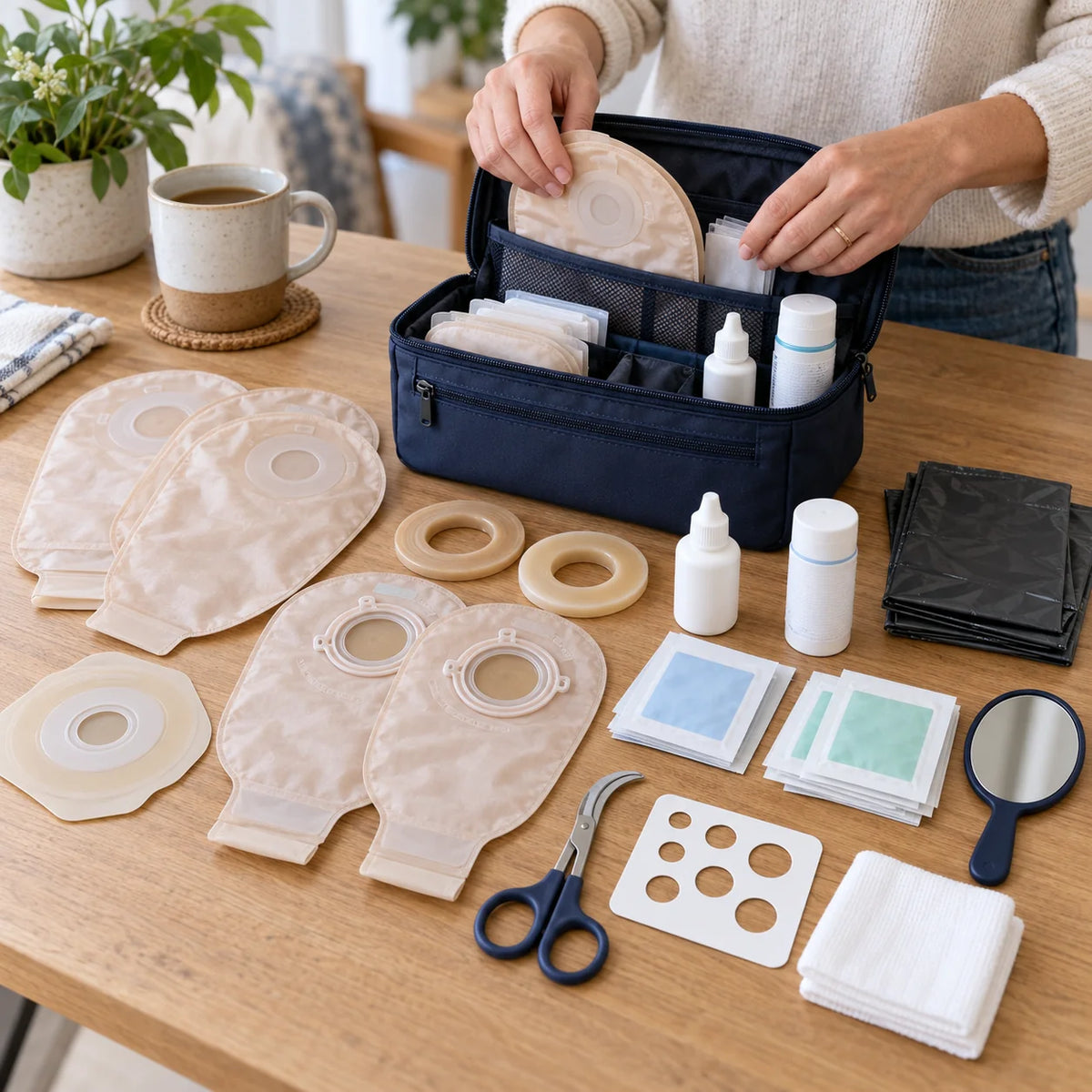
The night before ostomy surgery, one question gets asked in every ostomy community, every time: "Surgery is tomorrow -- what products do you actually recommend?" It's the right question. The supplies the hospital sends you home with are a starting point, not a verdict, and the difference between the products that merely work and the products experienced ostomates reorder for years is the difference between managing your ostomy and barely thinking about it.
This is our answer to that question -- built not from marketing claims but from what the ostomates who shop our store actually buy again and again. Every product here is a proven repeat-purchase item with live pricing, organized the way you'll actually use it: the core system, the seal-savers, skin protection, odor control, support, and the go-bag.
One important note before the list: this guide complements, not replaces, your WOC (wound, ostomy, and continence) nurse. They'll size your stoma, assess your abdomen, and tell you whether you need a flat or convex barrier. Bring this list to that conversation.
First: Don't Stockpile Yet
The most expensive mistake new ostomates make is buying cases of supplies in week one. Your stoma will shrink significantly over the first 6 to 8 weeks after surgery as post-operative swelling goes down -- which means the barrier size that fits in week two may gape by week six. Buy small quantities of cut-to-fit products while your stoma is changing, measure at every change, and only stock up once your size has been stable for a few weeks. (This is also why cut-to-fit barriers dominate this list -- they adapt as you change.)
The Core System: Barrier and Pouch
Most new ostomates do best starting with a two-piece system -- the barrier (the part that sticks to your skin) and the pouch attach separately, so you can change the pouch without disturbing the barrier, check your stoma easily, and burp gas without a full change. Our guide to choosing your first ostomy pouch walks through the one-piece vs. two-piece decision in depth.
The barrier our customers reorder more than any other premium option is the Hollister New Image CeraPlus 2-Piece Cut-to-Fit Skin Barrier ($33.46 per box of 5, 2-1/4" flange -- also in 1-3/4" and 2-3/4" flange sizes). The CeraPlus barrier is infused with ceramide -- the same lipid that keeps healthy skin's moisture barrier intact -- and it's an extended-wear formulation designed to protect the peristomal skin you're trying to keep healthy from day one. Cut-to-fit means it adapts to your changing stoma size through the whole healing period.
If your WOC nurse determines your stoma sits at or below skin level, the CeraPlus Cut-to-Fit Convex Barrier ($49.83 per box of 5) applies gentle pressure around the stoma to help it project into the pouch -- our guide to flat vs. convex barriers explains how to tell which you need. And for ostomates who find scissors awkward, the New Image FormaFlex Shape-to-Fit Barrier ($35.19 per box of 5) molds to size with your fingers -- no cutting at all.
Pair the barrier with drainable pouches from the two-piece drainable pouch collection -- drainable is the right default for a new ileostomy or colostomy while output is unpredictable.
The Seal-Savers: Paste and Barrier Rings
Ask ten experienced ostomates their number-one product and most will name something from this category. These are the gap-fillers that turn an okay seal into a reliable one:
- ConvaTec Stomahesive Paste ($10.42) -- the most reordered ostomy accessory in our store. A thin bead fills the skin creases and dips that leaks start from.
- Hollister Adapt Paste -- the easier-squeezing, lower-sting alternative.
- Barrier rings -- moldable rings that give 360-degree protection around the stoma and are gentler on fragile new skin than paste. Many new ostomates start with rings precisely because they're so forgiving.
New to these products? Our complete ostomy paste guide compares all the options and shows exactly how to apply them, and the barrier ring guide covers rings step by step. You don't need both paste and rings on day one -- pick one (rings are the gentler starting point), and add the other if your contours demand it.
Skin Protection: The Habit That Prevents Misery
Peristomal skin problems are the most common ostomy complication -- and the most preventable. Two products build the protective routine:
- Smith and Nephew Skin-Prep Protective Barrier Wipes -- wiped on before the barrier, they leave a breathable protective film that shields skin from adhesive trauma and moisture, and improves barrier adhesion.
- Adhesive remover wipes -- the product new ostomates most often don't know exists. Barriers should release with a remover wipe, not be peeled off by force; skin stripping from aggressive removal is how healthy peristomal skin becomes raw skin.
If your skin does become irritated in the early weeks -- it happens -- our guide to healing raw skin around your stoma covers the crusting technique every ostomate eventually learns.
Odor Control: The Confidence Product
The Hollister M9 Odor Eliminator Drops 8 oz ($22.47) is quietly one of the best-selling products in our entire ostomy department -- because a few drops in the pouch at each change or emptying genuinely eliminates odor rather than masking it, and that does more for early confidence than almost anything else. The 1 oz size ($4.29) lives in the go-bag, and the M9 unscented pump spray ($3.14) handles the bathroom air itself. Diet plays a role in odor too -- our ostomy diet guide covers which foods amplify and which reduce it.
The Support Belt: Buy It Before You Think You Need It
Up to half of ostomates develop a parastomal hernia within five years, and prevention starts in the early months -- exactly when most people haven't thought about it yet. The Coloplast Brava Ostomy Support Belt (also in small) is a stretchable, breathable belt that supports the abdominal wall around your stoma during coughing, lifting, and daily activity. Wear it once you're cleared for activity, especially for anything strenuous. Our parastomal hernia guide explains the why, and the exercise guide covers returning to activity safely.
The Go-Bag: Never Get Caught Out
Every experienced ostomate carries a small emergency kit, always. Build yours from day one:
- One complete change: barrier (pre-cut to your current size), pouch, and a barrier ring or travel paste
- Adhesive remover wipe and skin prep wipe (single-use wipes are made for exactly this)
- M9 drops 1 oz
- Zip-lock bags for disposal, a few paper towels, and disposable gloves
- A small bottle of water (for cleanup where sinks aren't handy)
It fits in a toiletry bag. Keep one in the car and one in your everyday bag, and restock it the same day you use it.
A Sample First Order
| Item | Price |
|---|---|
| CeraPlus Cut-to-Fit Barrier (box of 5) | $33.46 |
| Drainable pouches (matched to your flange size) | varies by size |
| Barrier rings (box) | varies by brand |
| Stomahesive Paste | $10.42 |
| Skin-Prep Barrier Wipes (box of 50) | see product page |
| Adhesive remover wipes | varies by brand |
| M9 Odor Eliminator Drops 8 oz | $22.47 |
| M9 Drops 1 oz (go-bag) | $4.29 |
| Coloplast Brava Support Belt | see product page |
That's a genuinely complete starter setup -- core system, seal protection, skin care, odor control, hernia prevention, and a go-bag -- without a single unnecessary gadget.
What NOT to Buy Yet
Equally important, and rarely said by anyone selling supplies:
- Cases of anything in one size -- not until your stoma size has been stable for several weeks
- Convex barriers -- only with WOC nurse guidance; convexity on a stoma that doesn't need it can cause pressure injury
- Every accessory at once -- start with the list above, add paste OR extra ring types only when a specific problem calls for them
- Specialty garments and wraps -- fine later; in the first weeks, comfort and healing come first
You've Got This
The colectomy-eve question always gets one more answer from the community, repeated more than any product name: it gets easier. The routine that feels overwhelming in week one is a five-minute habit by month three. Start with proven products, protect your skin from day one, keep the go-bag stocked, and lean on your WOC nurse -- and when you're ready to go deeper, our complete guide to living confidently with an ostomy answers the ten questions every new ostomate asks.
Shop Related Products
- Hollister New Image CeraPlus Cut-to-Fit Barriers -- the ceramide-infused extended-wear starting point
- New Image FormaFlex Shape-to-Fit Barriers -- no-scissors alternative
- Two-Piece Drainable Pouches
- ConvaTec Stomahesive Paste and Hollister Adapt Paste
- Barrier Rings and Seals
- Skin-Prep Protective Barrier Wipes
- Adhesive Remover Wipes
- M9 Odor Eliminator Drops
- Coloplast Brava Ostomy Support Belt
- Browse the Full Ostomy Supplies Collection
Disclaimer: This information is intended for educational purposes only and should not replace advice from your healthcare provider, surgeon, or WOC nurse. Barrier type and sizing should be determined with your WOC nurse, particularly in the weeks after surgery while your stoma is changing size. If you experience signs of infection, severe skin breakdown, no stoma output with cramping, or other concerning symptoms, contact your care team promptly.